
Compression stockings for edema ttreatment
We are more. We are curaflow!
Every day is more enjoyable when you feel good. That’s why we developed made-to-measure VenoTrain curaflow and VenoTrain curaflow strong. These versatile and colourful compression garments adapt perfectly to the individual contours of the legs, arms, hands or chest (thorax) of people with lymphedema and lipedema. VenoTrain curaflow and VenoTrain curaflow strong relieve pain caused by tension and provide noticeable relief – all with significantly greater wearing comfort that you’ll love. So you can go about your daily life feeling carefree, confident and attractive. Say “hello” to your strong self!


VenoTrain® curaflow stockings
Card subtitle
Compression stocking for targeted edema treatment in the leg

VenoTrain® curaflow arm sleeves
Card subtitle
Compression stocking for targeted edema treatment in the arm

VenoTrain® curaflow Thorax
Card subtitle
Compression stocking for targeted edema treatment in the torso

My compression gives me a sense of security and helps me feel more comfortable. For me, it’s my second skin and the perfect companion for every day.
Lina
Influencer with lipoedema
What makes our compression special

Additional features of VenoTrain curaflow
Other products for edema therapy:

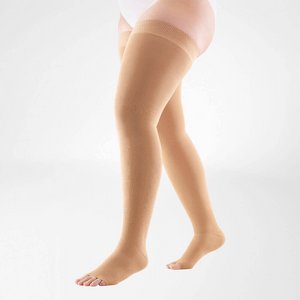
VenoTrain® delight
Card subtitle
Compression stocking for severe vein problems, lymphedema and lipedema
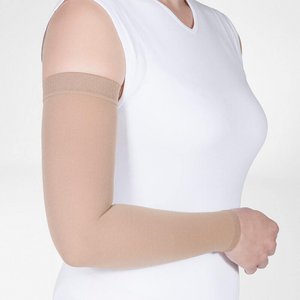
Treating lipedema and lymphedema with flat-knit compression stockings
Lymphedema is an accumulation of lymphatic fluid and can be congenital or develop as a result of various diseases, surgery or injuries. In addition to the legs and arms, other parts of the body can also be affected. With lipedema, by contrast, swelling occurs only in the legs or arms due to a fat distribution disorder. The affected areas are sensitive to pressure and can cause very severe pain.
Thanks to their fabric stiffness, flat-knit compression stockings relieve symptoms of lipedema and lymphedema. In lipedema therapy, they are also highly suitable for advanced stages. In the treatment of lymphedema, compression garments help slow further progression; compression is also used to provide relief in advanced stages.
As edema affects body proportions to varying degrees, your compression garments for the legs, arms and thorax should be individually made to measure. It is best to discuss this with your doctor or a specialist at a medical supply retailer. Taking your condition and daily demands into account, the specialist retailer will find the most suitable compression solution for you.
Flat-knit compression stockings – everything you need to know
Medical compression stockings manufactured using the flat-knit technique are used for lipedema and lymphedema to help prevent fluid accumulation. They are knitted back and forth in rows on a flat knitting machine. The stitch size remains the same in each row, while the number of stitches continually varies. This regulates the pressure gradient and allows each circumference to be fitted with millimetre precision. (Small circumference = fewer stitches, large circumference = more stitches.) Flat-knit compression garments, which are joined together with a special seam, are also stronger, denser and therefore more durable than circular-knit garments.
Circular-knit compression stockings are manufactured in a cylindrical shape on a circular knitting machine, with the same number of stitches at the ankle as at the thigh. Changes in circumference and the pressure gradient are regulated by the yarn tension, in other words, by the stitch size. (Small circumference = small stitches, large circumference = large stitches.) With this information in mind, think about the distinctive leg shapes we encounter in people with edema. How could a stocking with the same number of stitches from top to bottom fit these shapes? Circular-knit stockings are also comparatively thin and elastic, which is suitable for most venous conditions. However, compression garments for lymphedema and lipedema need to provide significantly greater stability to exert a relatively low “resting pressure” when the muscles are relaxed. They must also provide significantly higher “working pressure” to resist the muscles as they contract. And this is precisely what is essential in edema therapy.
In principle, any doctor familiar with the condition can prescribe compression stockings. You can therefore speak to your GP, specialist in internal medicine, phlebologist or angiologist about compression garments. However, it is important that the doctor has experience with the condition so they can decide whether and when compression stockings should be prescribed. Compression must form part of a treatment plan, and the diagnosis must be confirmed beforehand. A GP will generally not issue the initial prescription, as accurately diagnosing lymphedema or lipedema is complex and requires specialist resources. For subsequent prescriptions, however, your GP is the right person to contact for further compression garments. They must be informed of the specialist’s diagnosis and treatment decision.
Medical compression stockings are divided into four compression classes (CCL 1 to CCL 4). The higher the class, the greater the compression pressure exerted by the knitted fabric. More precisely, this refers to the pressure applied at the ankle, usually measured in kPa (kilopascals) or mmHg (millimetres of mercury). A pressure of 18 to 21 mmHg, for example, corresponds to compression class I.
For conditions affecting the lymphatic system, no specific compression class can be assigned as a general rule. Your doctor determines the exact level of compression, or resting pressure, you need by considering various individual factors. These include:
Because every body is unique, our compression products can be tailored to each individual’s needs with numerous additional options:
- Closed toe: Prevents the knitted foot section from slipping and creases from forming over the instep while walking.
- 90° heel: Reduces creasing over the instep, preventing constriction and improving joint function.
- Slanted edges for arms and legs: Ensure the required pressure gradient extends to the metatarsophalangeal joints and prevent constriction in cases of soft tissue on the thighs and upper arms, swelling on the top of the foot and toe deformities.
- Hallux section: Reduces pressure points caused by misalignment of the big toe.
- Instep extension: Reduces creasing and constriction where tissue overhangs the instep.
- Silicone top band: Keeps knee-high and thigh-high stockings securely in place.
- Silicone grip patches: Provide additional support to keep stockings in place on distinctly conical legs or very soft tissue.
- Waist attachment: Ensures a secure fit for people who cannot tolerate silicone top bands.
- Pressure pad: Ensures optimal pressure distribution for edema and hardened tissue around the ankle.
- Lymph pad: Provides optimal pressure distribution and increased pressure for locally pronounced edema or hardened tissue.
- Zip: Makes garments easier to put on for people with rheumatism, arthritis or incontinence.
- Toe cap and attached toe sections: Reduce edema formation in cases of lymphedema affecting the forefoot and toes, as well as edema on the top of the foot.
- Compressive gusset: Provides increased pressure for genital edema.
- Multi-piece garments: Make garments easier to put on for people with functional limitations or restricted mobility.
- Lining fabric: Protects the skin from excessive mechanical stress, for example where there is irritation in areas where joints bend.
Discuss which additional options are suitable for your individual needs with your doctor so they can be correctly specified on your prescription.
In general, compression stockings are designed to maintain their medical effectiveness, meaning their compression effect, for six months of use. Manufacturers, including Bauerfeind, guarantee that the specified compression pressure will only begin to decrease after this period when the stockings are worn daily under normal conditions. However, correct handling and care of your compression garments are also essential to prevent their effectiveness from being reduced prematurely.
What should you do if your stockings wear out prematurely?
It is also important to know that factors such as work-related demands or strain associated with your condition can cause considerable differences in how long compression products last. If your stocking wears out prematurely, for example due to frequent use during sport, a replacement prescription may be needed sooner. The same applies if your body measurements change significantly. If this happens, be sure to speak to your doctor promptly about a new prescription. As you know, the precise fit of your compression garments is essential for their effectiveness and your health.
In Germany, medical compression stockings are manufactured according to strict rules set out in the RAL-GZ 387 guideline. Only medical compression stockings bearing the RAL quality mark guarantee medical benefits, are eligible for reimbursement by statutory health insurance providers and are included in the German medical aids directory. The guideline aims to ensure ongoing product quality assurance.
The foundations for this guideline were laid back in 1955. That year, several German compression stocking manufacturers, including Bauerfeind, founded the Gütezeichengemeinschaft Medizinische Gummistrümpfe e.V. (Quality Mark Association for Medical Elastic Stockings), which has since been renamed Gütezeichengemeinschaft Medizinische Kompressionsstrümpfe e.V. (Quality Mark Association for Medical Compression Stockings). The association was founded to define and establish universally applicable and recognised quality requirements for compression stockings through the RAL quality mark. RAL stands for “Reichs-Ausschuss für Lieferbedingungen” (Reich Committee for Delivery Terms).
The quality mark was finally introduced in Germany in 1968. In 1972, a set of basic rules was agreed between the German Society of Phlebology and Proctology, the German Federal Guild Association for Orthopaedic Technology, the manufacturers belonging to the quality mark association and the health insurance providers. Since then, only medical compression stockings bearing the RAL quality mark have been supplied by medical supply retailers and reimbursed by health insurance providers.
The RAL standard for medical compression stockings covers, among other things, classification into compression classes, defined pressure profiles, specific measuring points on the leg and the stocking types derived from them, certain minimum yarn thicknesses and further construction specifications that ensure a service life of six months. Only materials that are safe for human health may be used, and labels, instructions for use and packaging must also meet specific requirements.
To put it simply: a compression stocking bearing the RAL quality mark is always a good choice.